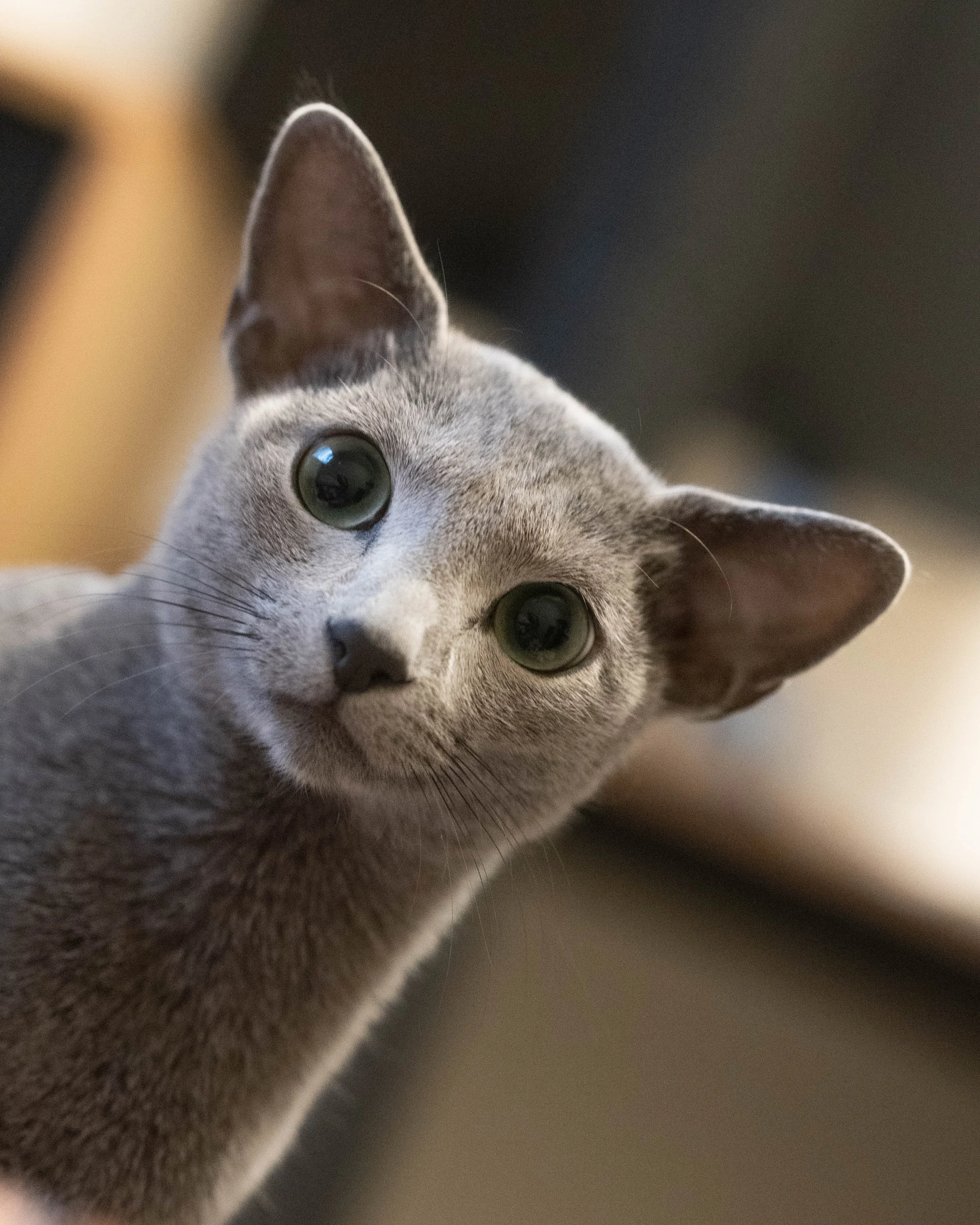
Registering a cattery name with CFA (Cat Fanciers' Association) or TICA (The International Cat Association) does not automatically make someone a reputable breeder. Many backyard breeders can still market themselves as TICA registered or XXXX registered.
Why is that?
Well, it is relatively easy to claim to be a “CFA-registered” or “TICA-registered” cattery. Registering a cattery name generally involves submitting an application, paying a fee, and receiving a registration number… and that's it! It's something almost anyone can do.
However, a registered cattery name alone does not establish the quality, pedigree, or credibility of a breeding program. More importantly, it does not necessarily mean that the breeder's cats are individually registered with that organization or that they meet its breed standards.
Unfortunately, some backyard breeders may use their cattery registration as a way to establish credibility with prospective kitten buyers, even when the kittens they produce have no documented pedigree or registration with that organization. This can be misleading, especially for buyers who may not realize that registering a cattery name and registering a pedigreed cat are two entirely different things.
Building a reputable breeding program involves much more than obtaining a registration number. Mentorship from an experienced, established breeder can be incredibly valuable, particularly someone who is willing to share well-documented bloodlines, provide guidance on responsible breeding practices, and help newer breeders understand how to evaluate their cats and make thoughtful breeding decisions in accordance with the breed standard.
CFA vs. TICA: Understanding Pedigree Requirements
CFA and TICA have different pedigree and registration requirements. CFA maintains stricter ancestry requirements for Russian Blues, including an eight-generation pedigree requirement, while TICA allows certain registration classifications based on five generations of documented ancestry.
Consider this: if a TICA-registered Russian Blue has a domestic cat in its sixth generation, can it truly be considered a purebred Russian Blue under CFA's requirements?
Not necessarily.
A Russian Blue may qualify for TICA registration but not necessarily meet CFA's pedigree requirements. CFA-registered Russian Blues are generally eligible for TICA registration, but the reverse is not always true.
CFA has more stringent pedigree requirements for Russian Blues, providing an additional level of confidence when evaluating a cat's documented ancestry. TICA's less restrictive registration requirements may make it easier for breeders to register cats with questionable or insufficiently verified pedigrees. Unfortunately, this can also make TICA an attractive option for backyard breeders or less responsible breeding programs whose cats may not qualify for CFA registration, and if you are reading this, you probably already encounter some, and you wonder why a registry will do this? It’s because they make money that way.
Another note is that CFA was established before TICA and has played a significant role in the development and preservation of Russian Blue bloodlines, Russian Blue is one of the oldest breeds, and throughout the years, legit Russian Blue breeders in the United States maintain their breeding programs through CFA, where pedigrees have been documented across generations.
It's also worth noting that many reputable CFA breeders register their cats with TICA as well, as long as they are CFA registered and not single registered with TICA, their cats are from legit lines.
Some backyard breeders advertise themselves as CFA- or TICA-registered, yet their cats may look very different from what the breed standard describes. In some cases, they may even resemble ordinary domestic blue cats rather than well-bred Russian Blues. However, by presenting registration papers and a registered cattery name, these breeders can give prospective kitten owners the impression that their cats are legitimate, well-bred examples of the breed. This happens all around the world.
Unfortunately, some breeders do acquire cats from questionable sources and breed primarily to produce kittens for sale, with little consideration for pedigree quality, breed type, temperament, or long-term improvements. The reality is that registration alone do not guarantee breed quality, proper conformation, or a breeder’s commitment to preserving the breed standard.
European Lines vs. American Lines
Another common misconception we’ve noticed in the Russian Blue community, particularly among some backyard breeders or scammers, is the distinction between so-called “European lines” and “American lines.”
Historically, different registries and breeding populations developed somewhat different interpretations of the Russian Blue standard. While there are certainly Russian Blues in Europe with a more traditional appearance, breeding preferences and standards have continued to evolve over time, and modern pedigrees are often much more interconnected than people realize.
The Fédération Internationale Féline (FIFe) is one of the largest and most prominent cat registry organizations in Europe. If you look at the pedigrees of many successful, award-winning Russian Blues and well-established breeding programs in Europe today, you'll find that American CFA bloodlines have played a significant role in their development. Many prominent European breeders have incorporated these lines into their programs, making the distinction between “European” and “American” lines far less clear than it once was.
In my opinion, this distinction has become less relevant in modern breeding. Times have changed, and the breed continues to evolve. Unfortunately, these labels are sometimes used to explain differences in appearance that may actually reflect individual breeding choices, selective breeding practices, or varying interpretations of the breed standard.
Rather than focusing solely on whether a Russian Blue is described as having “European” or “American” lines, I believe it is far more meaningful to look at the cat's actual pedigree, the breeder's goals, and how closely the cat represents the breed standard of the registry under which it is bred.
Here is what’s going on in Europe:
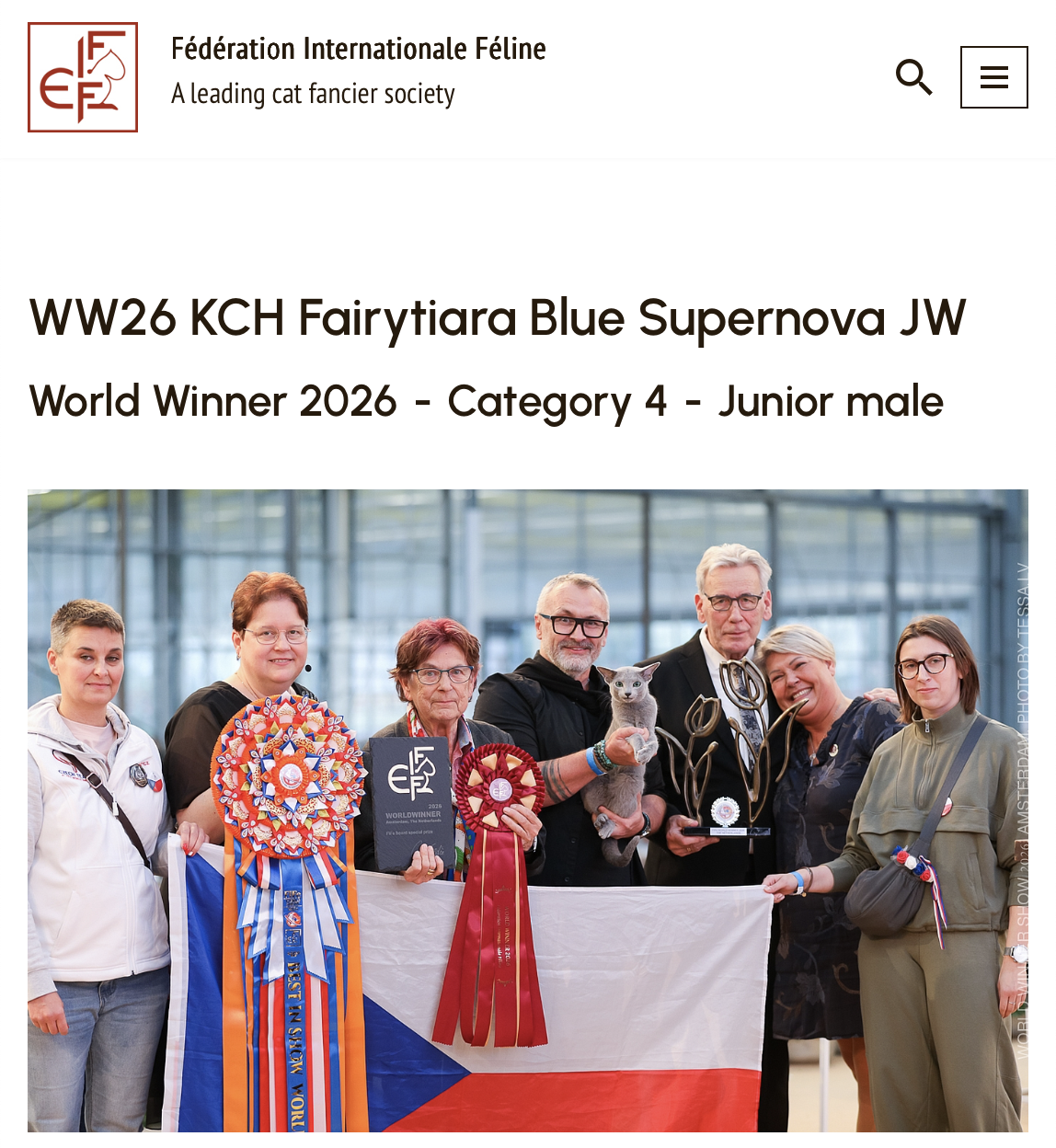
The 2026 FIFe World Winner, despite competing in Europe, is a direct offspring of American CFA bloodlines. “American CFA look.” Congrats to the breeders and the owners!
Here is another one, Giorgio Armani, an “European” brand, features American CFA line Russian Blues. The breeder and owners both bred for CFA American lines.

So, what is this European bunny ears feature? A Russian Blue does not have oversized, upright "bunny ears" simply because it comes from a "European line."
Breed type should be evaluated against the applicable breed standard, not explained away by a geographic label.
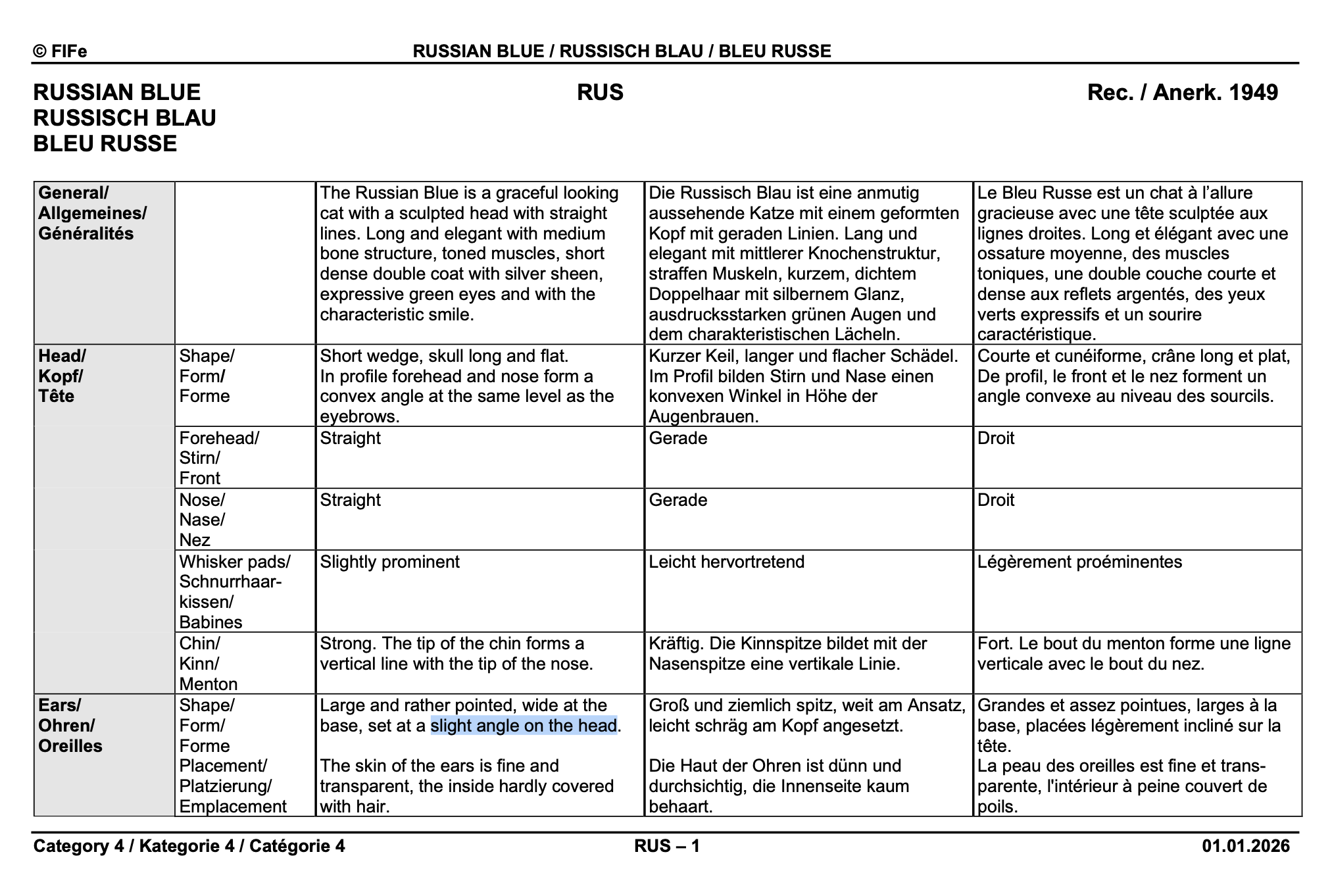
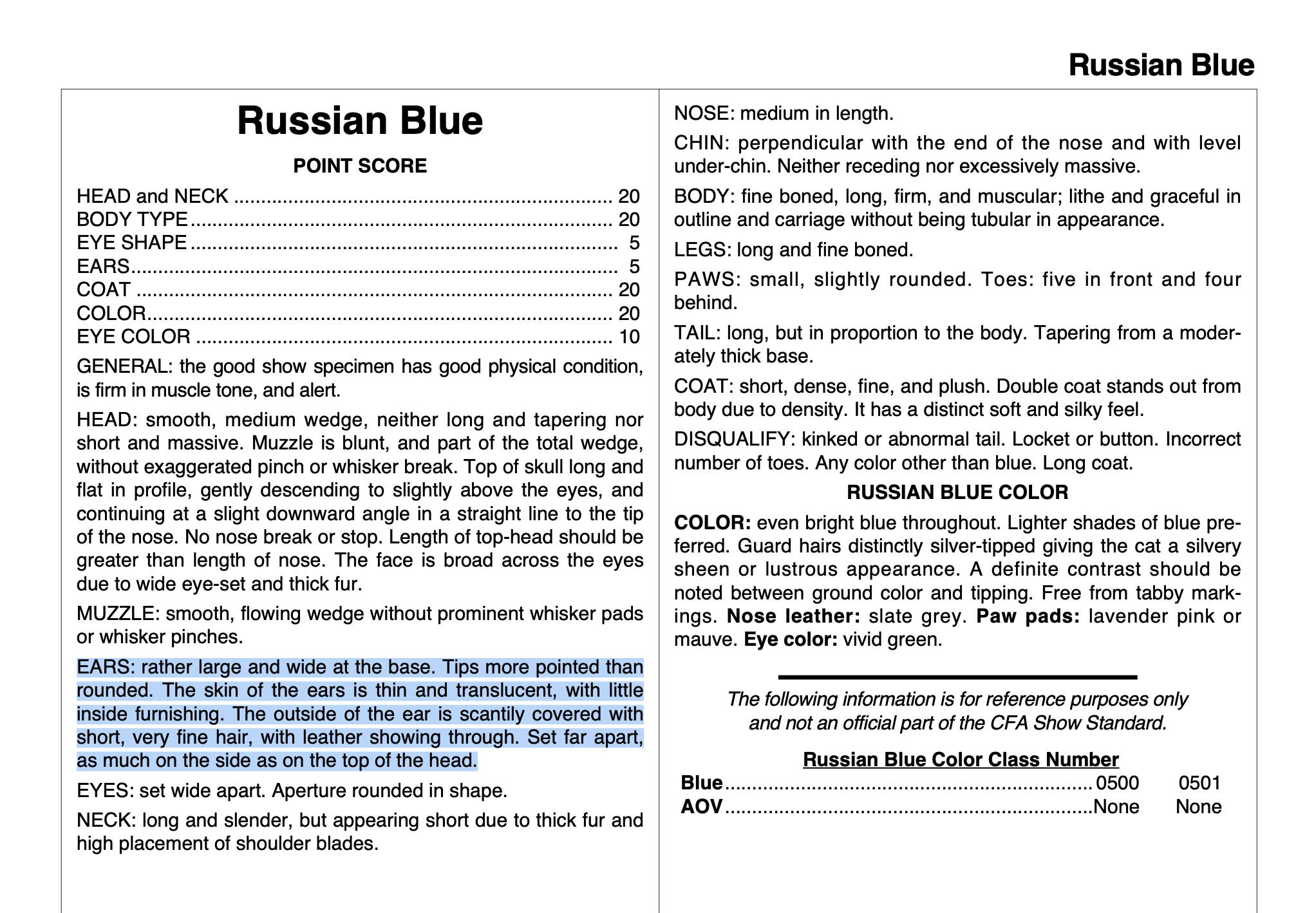
CFA, TICA and FIFe have all published their breed standards describing the desired characteristics of a Russian Blue, including head shape, ear placement, body structure, coat texture, and overall balance. None asked for bunny ears.
Here are the official breed standard for Russian Blues across different registry:
FIFe ( Fédération Internationale Féline )
Breed standard link: https://fifeweb.org/wp-content/uploads/2023/10/RUS.pdf
Breed presentation PDF: https://fifeweb.org/wp-content/uploads/2026/10/Breed-Profile-RUS.pdf
CFA ( Cat Fanciers’ Association )
Breed standard: https://cfa.org/wp-content/uploads/2024/03/russian-blue-standard.pdf
Breed Presentation: https://cfa.org/wp-content/uploads/2024/05/russian-blue-presentation.pdf
TICA ( The International Cat Association)
Breed standard: https://tica.org/phocadownload/rb.pdf
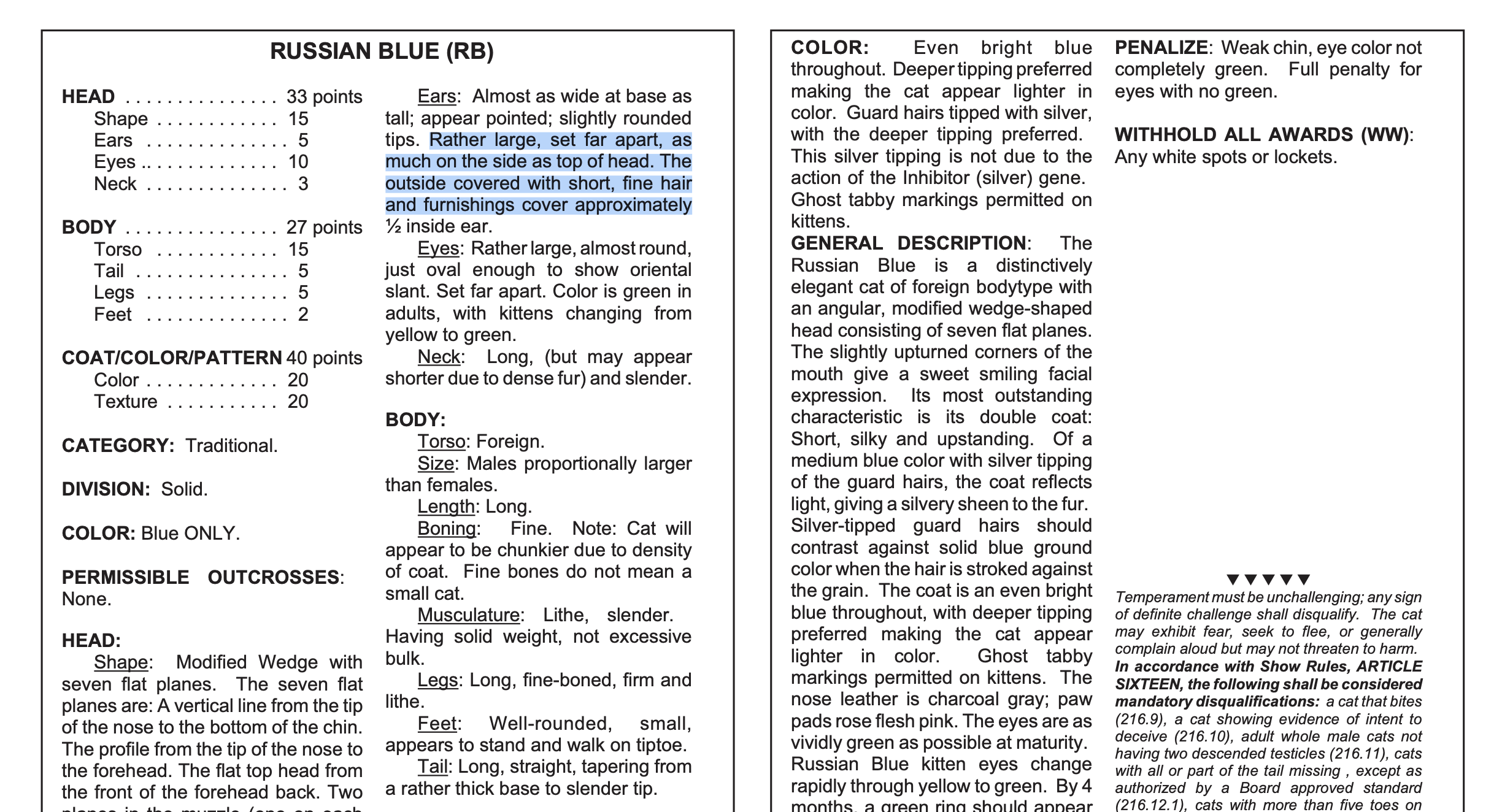
While the breed standards are not entirely identical across registries, no major registry calls for oversized “bunny ears” in its Russian Blue breed standard. There is no justification for deliberately breeding cats that do not conform to the standard, especially when the goal of responsible breeding should be to preserve and improve the breed, rather than simply produce kittens for profit.
Breeders should understand the standard they are breeding toward and be able to explain how their cats reflect it. Claiming “I breed European lines, so my cats look different” is not a substitute for proper breed evaluation, it shows a lack of commitment to the breed standard. SO many scammers use those lines.
That goes my next topic… one should breed for a purpose… that is to improve the breed.
Responsible Breeding Should Have a Purpose
In my opinion, every breeding should be planned with a purpose.
No cat is perfect, and even outstanding show cats have strengths and weaknesses. The goal is not to produce a flawless cat, but to make thoughtful breeding decisions that preserve desirable characteristics and improve areas that need refinement including better health.
If a breeder consistently produces cats that do not resemble the breed standard and makes little effort to improve those traits, it raises an important question:
Are they breeding to preserve and improve the Russian Blue, or simply to produce kittens for sale?
There is a meaningful difference between the two.
Responsible breeding involves understanding pedigrees, studying genetics, evaluating structure and temperament, and carefully selecting breeding pairs that complement one another.
Simply pairing two cats and producing kittens does not, by itself, demonstrate a commitment to breed preservation.
Why Showing Your Cats Matters
One may ask: How do you know whether you're breeding toward the standard?
You stay educated, and you show your cats!
How do you evaluate your cats' temperament outside their familiar home environment?
You show your cats!
How do you demonstrate that your cats represent the breed standard and that their pedigrees are recognized by the registry?
You participate in recognized cat shows, where eligible cats are evaluated by qualified judges.
Showing is one of the most valuable tools available to breeders.
Almost every cat is a sweetheart in its own home, but the show environment presents an entirely different set of challenges.
A show cat must be comfortable being handled by unfamiliar people, exposed to different sounds and surroundings, and placed in an environment with many other cats and people.
This requires socialization, confidence, adaptability, and a stable temperament.
A cat that behaves beautifully at home may respond very differently in a show hall.
Of course, not every wonderful breeding cat enjoys showing, and not every responsible breeder actively campaigns cats. However, participation in the show community provides valuable opportunities for education, mentorship, and independent evaluation.
Showing is not simply about winning ribbons or collecting titles.
It allows breeders to have their cats evaluated against the breed standard, understand their strengths and weaknesses, and make more informed decisions for future generations.
Titles also provide a documented record of a cat's achievements within a recognized registry. While a title alone does not guarantee breeding quality, it demonstrates that the cat has been evaluated in competition.
Should You Question Breeders Who Don't Show?
I believe prospective kitten buyers should feel comfortable asking breeders why they do or do not participate in cat shows.
There may be legitimate reasons why a breeder does not show regularly. However, breeders should still be able to explain how they evaluate their cats, which breed standard they follow, and how they make their breeding decisions.
If a breeder claims to produce exceptional Russian Blues but has never participated in cat shows, sought independent evaluations, or demonstrated a clear understanding of the breed standard, those claims deserve closer examination.
A reputable breeder should welcome thoughtful questions about their cats’ pedigrees, registration, health testing, temperament, and breeding goals.
The important question is not simply whether a breeder has registered cats, but what they are actually doing to preserve and improve the breed.
If a breeder consistently breeds pet-quality cats, how are those breeding decisions contributing to the improvement of the breed? If they deliberately select cats who don’t meet the standard, how does that align with the standards of the registry they claim to represent?
Registration or having a cattery number with a registry alone does not demonstrate a commitment to the breed standard, and simply producing more kittens should never be confused with responsible breed preservation.
Final Thoughts
A registered cattery name is only the beginning. It does not automatically establish credibility, breeding knowledge, or a commitment to the breed standard.
Pedigrees matter. Breed type matters. Temperament matters. Health matters. And the willingness to learn, seek evaluation, and improve matters just as much.
Responsible breeding is about preserving and improving the breed for future generations, not simply producing kittens for sale.
That is the standard I believe every serious breeder should strive toward.
Stay educated and stay away from BYBs!